For developers
Ship a kit. Get paid. Move on.
Developers, prompt engineers, and automation pros wrap a real repo in a manifest, list it, get paid, and let buyers run it in Claude Code or Codex.
10%
Free tier take
One-off or subscription
1 cmd
Install path
curl installer | node <you>/<kit>
100%
MIT default
Override allowed
How it works
From repo to revenue in four steps.
Push a manifest, get a checkout. We host the rail.
Push a platform.yaml
Drop a manifest at the root of your GitHub repo. We parse it on push.
Get a SEO page
A public page goes live at /skills/yourname/yourkit with OG image and structured data.
Buyer pays
Stripe Connect by default, Polar.sh swap-in. Magic-link signs them in.
Buyer installs
One dashboard command. Skill lands in ~/.claude/skills with mcp.json for Claude Code and Codex.
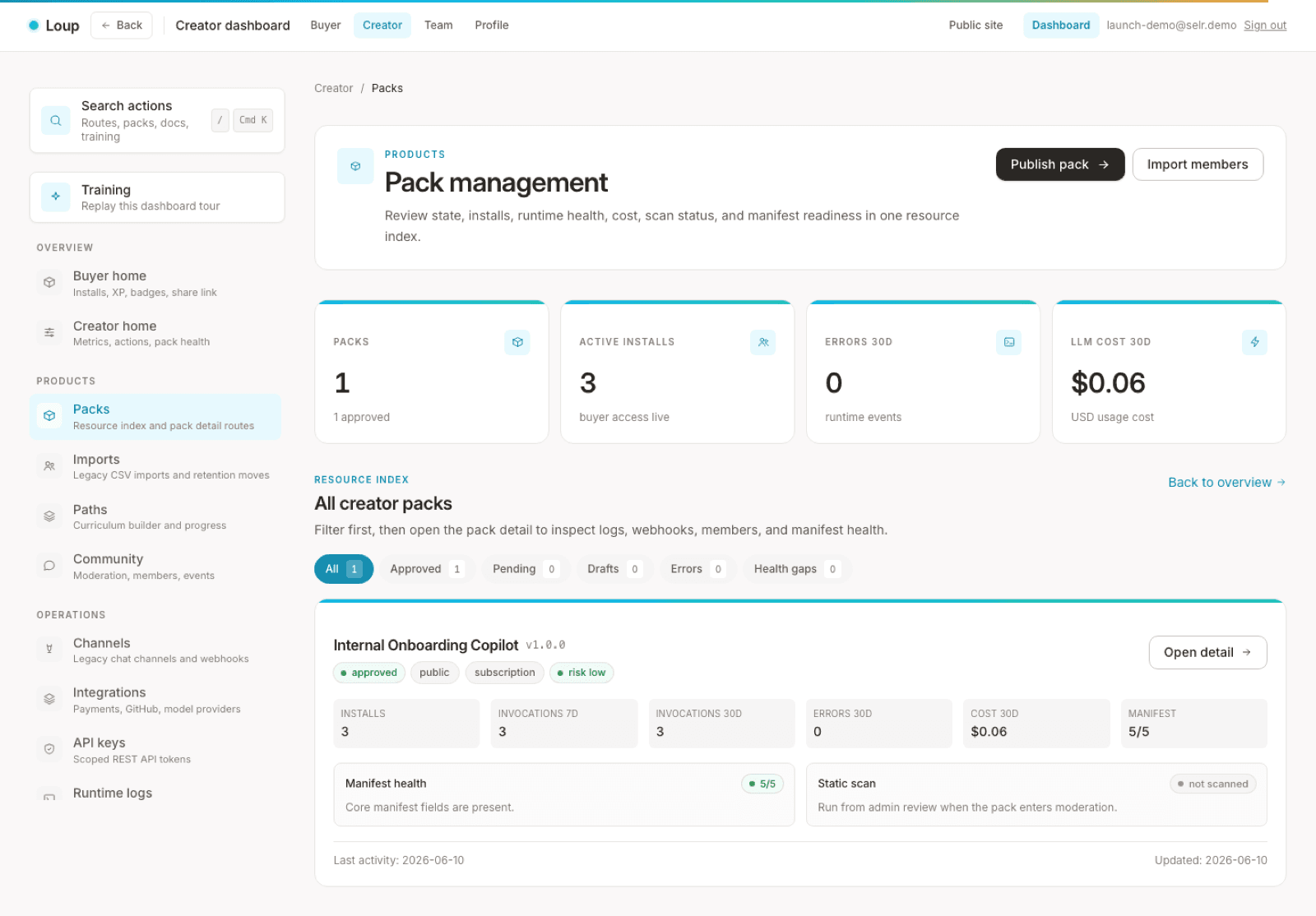
Every pack in one resource index.
State, installs, runtime errors, LLM cost, and manifest health per pack, without leaving one screen.
loup.app/dashboard/creator/packs
platform.yamlmain
# platform.yamlname: Voice-Graded Content Writercreator: selr-ailicense: MITpricing:model: subscriptionprices: { AUD: 19, USD: 13 }trial_days: 7runtime: mcpentrypoint: ./skills/voice/run.tssurfaces: [claude-code, codex]repo: github.com/selr-ai/voice-graded
Buyers keep your code
No lock-in. No dependency on us.
The kit is a real GitHub repo. Once a buyer installs it, the files live on their laptop. If we disappear tomorrow, the kit still works. That is the deal.
Read the manifest specInstall in one command
The buyer never opens a config file.
Magic-link binds their account. The installer fetches the pack, validates the manifest, registers the MCP. Two commands, zero ceremony.
terminalbash
$ npx @louphq/install selr-ai/voice-graded --token loupit_...Resolving manifest...Writing ~/.claude/skills/selr-ai__voice-graded# Installed v1.0.0# Next: open in Claude Code or Codex.The whole pitch is git push + earn. I keep the repo. Loup handles checkout, the SEO page, the install rail, the affiliate ledger. I’m the marketer for one thing only - the kit itself. That’s the right division of labour.